

We are living in an era where internet traffic is growing every day and the usage rate of mobile devices is rapidly increasing. Cloud computing solutions seem to have responded to this growth for now. However, while these solutions make life easier for end users, they also bring along many challenges for data centers.
Cloud technology manufacturers and large service providers serving end users (such as Google, Microsoft, Amazon, etc.) are transforming their network and storage topologies into uninterrupted systems that offer price–performance advantages and ease of use. However, unlike traditional scale-up architectures, this growth is occurring in line with cloud terminology as scale-out architectures.
In order to adapt to scale-out architectures and virtualization technologies that have become widespread with cloud computing, the data storage world continues to develop new technologies. At the core of scale-out growth architectures, instead of classical SAN topologies, next-generation Ethernet-based technologies reaching up to 100 GbE levels are becoming prominent.
Mellanox, the world’s leading manufacturer of InfiniBand and Ethernet technologies, has developed new technologies in recent years that multiply the traditional cost and traffic limitations of Fibre Channel (FC) in the storage sector through Ethernet. As of the end of 2016, with the production of 100 Gbps ports, Mellanox continues to maintain its leadership over other manufacturers with its advantages in latency, cost efficiency, and performance.
As a technology partner of NGX Storage, through our joint efforts with Mellanox, we are able to deliver data transmission speeds of up to 420 Gbit per controller. With its high performance and low latency, our All-Flash architecture is rapidly progressing toward becoming a core component of the future cloud computing infrastructures.
To access the related solution brief, please click here.
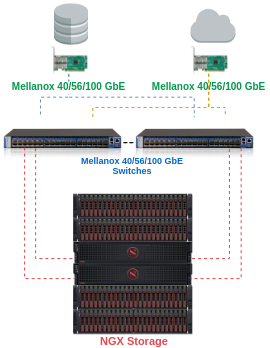
In traditional SAN topologies, communication between servers and storage systems is carried out through ports with maximum access speeds of 8 Gbps or 16 Gbps. Organizations seeking a SAN-based storage solution are required to make additional investments in SAN switches, FC HBAs, and cabling, all of which are more costly compared to Ethernet-based solutions.
Moreover, in classical SAN topologies, the risk of not being able to protect the initial investment may lead to potential cost increases. The primary factors behind this situation are the port-based licensing costs of FC HBA cards and SAN switching devices on the storage system, as well as the administrative overhead of managing FC topologies.
Today, while SAN architectures operate at 4, 8, and 16 Gbps (and soon 32 Gbps) levels, with NGX Storage and Mellanox solutions, it is possible to build an Ethernet-based storage network at speeds of 10, 25, 40, 50, 56, and 100 GbE.
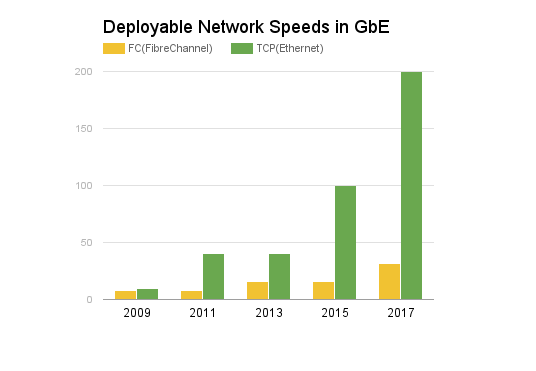
As shown in the chart above, the development of FC and TCP technologies between 2009 and 2017 can be observed. While FC technology has scaled with 8, 16, and 32 GbE, TCP technology has expanded much more rapidly with 10, 40, 100, and 200 GbE. The continuous growth in read and write performance of data storage technologies (All-Flash) also requires a corresponding increase in instant access speeds.
NGX Storage offers fully integrated solutions, allowing you to use Fibre Channel, iSCSI, NFS, and SMB protocols simultaneously. Within this framework, you can preserve your existing storage network infrastructure while seamlessly benefiting from new technologies.
For the protection of your data center investments and cost-effective solutions, NGX Storage products represent the right choice.