


Across Europe, the conversation around data sovereignty is no longer a niche policy debate. It’s showing up in boardrooms, procurement decisions, and long-term infrastructure strategies. What used to be a legal or compliance concern is now being treated as something far more fundamental: a question of control.
Because data is no longer just data.
It is operational continuity.
It is competitive advantage.
And increasingly, it is geopolitical leverage.
That shift didn’t happen overnight. It’s been shaped by tightening regulations, growing uncertainty in global relations, and the sheer acceleration of data-heavy technologies like AI. As organisations scale their digital capabilities, they are also starting to ask a more uncomfortable question:
Who is actually in control of the infrastructure we depend on?
And this is where the reality becomes harder to ignore.
A Market Built Elsewhere
If we step back and look at the numbers, the picture is clear.
Around 70% of Europe’s cloud market is controlled by US-based providers, primarily Amazon Web Services (AWS), Microsoft Azure, and Google Cloud. These platforms are not just popular; they are foundational. They power everything from enterprise storage and analytics to entire SaaS ecosystems that businesses rely on daily.
In many organisations, these technologies are so deeply integrated that they’re no longer seen as external dependencies. They’re simply “the way things work.”
But that normalisation is part of the issue.
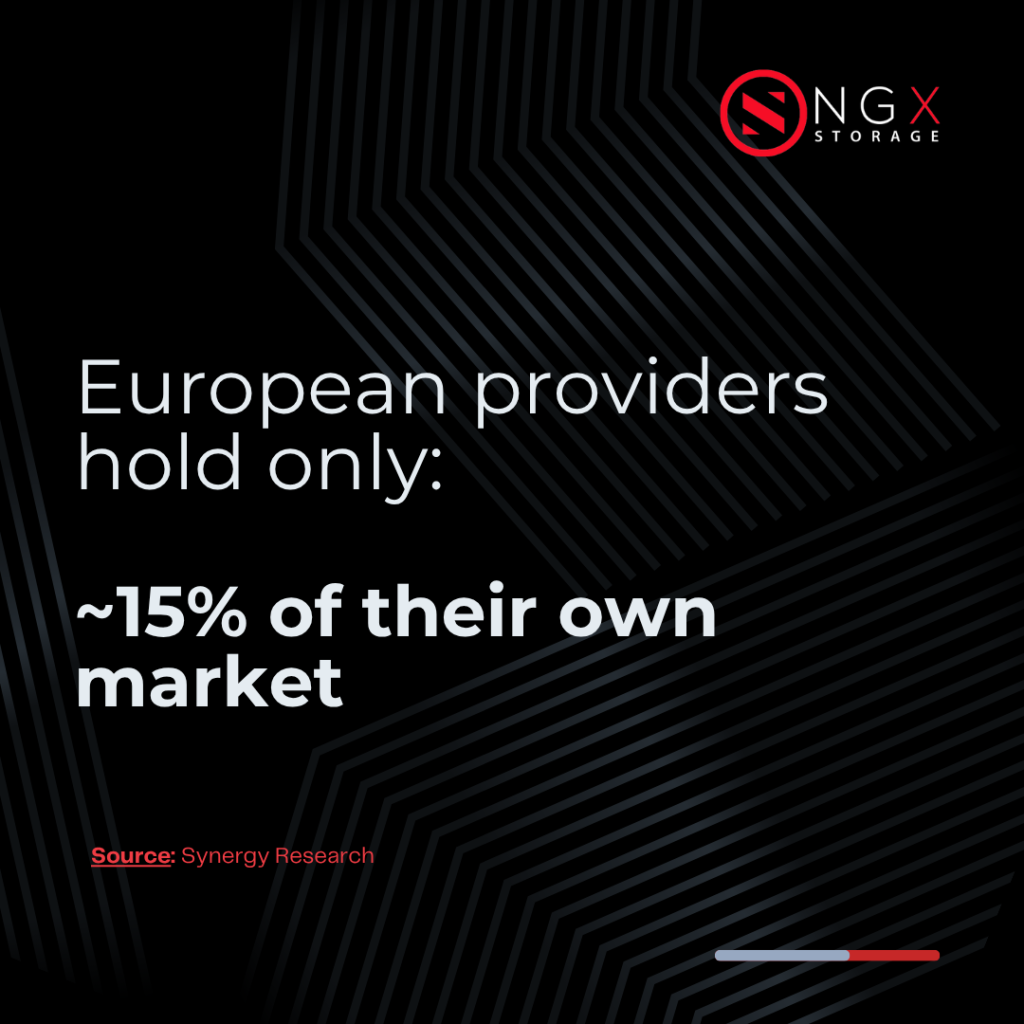
Because at the same time, European providers account for only about 15% of their own market. Not because demand isn’t there, but because the infrastructure landscape has already been shaped — and largely captured — by external players.
This is not just a question of competition. It’s a structural reality.
Europe is building its digital future on platforms it does not control.
And while those platforms are undeniably powerful, scalable, and mature, they also operate within governance frameworks that are not European by design. That creates a layer of dependency that goes beyond technology, into policy, jurisdiction, and long-term strategic autonomy.
When Infrastructure Becomes a Question of Control
Market share tells part of the story, but it doesn’t quite capture what’s really at stake.
Because cloud is no longer just a layer of convenience sitting somewhere in the stack. It has quietly become the foundation.
Today, cloud infrastructure supports core enterprise systems, public services, financial operations, healthcare platforms, and increasingly, the environments where AI models are trained and deployed. These aren’t edge cases or secondary workloads. They are the systems organisations depend on to function, consistently, securely, and at scale.
And that changes the nature of the conversation.
When these critical layers are primarily operated by external providers, the question shifts. It’s no longer just about performance benchmarks or pricing models. It becomes about control, who owns the infrastructure logic, who defines the rules it operates under, and how resilient it remains under pressure.
At that point, data sovereignty stops being an abstract, policy-driven idea.
It becomes something operational. Something that directly shapes how infrastructure decisions are made.
A Dependency That Keeps Deepening
What makes this even more complex is that the current structure isn’t static. It’s deepening.
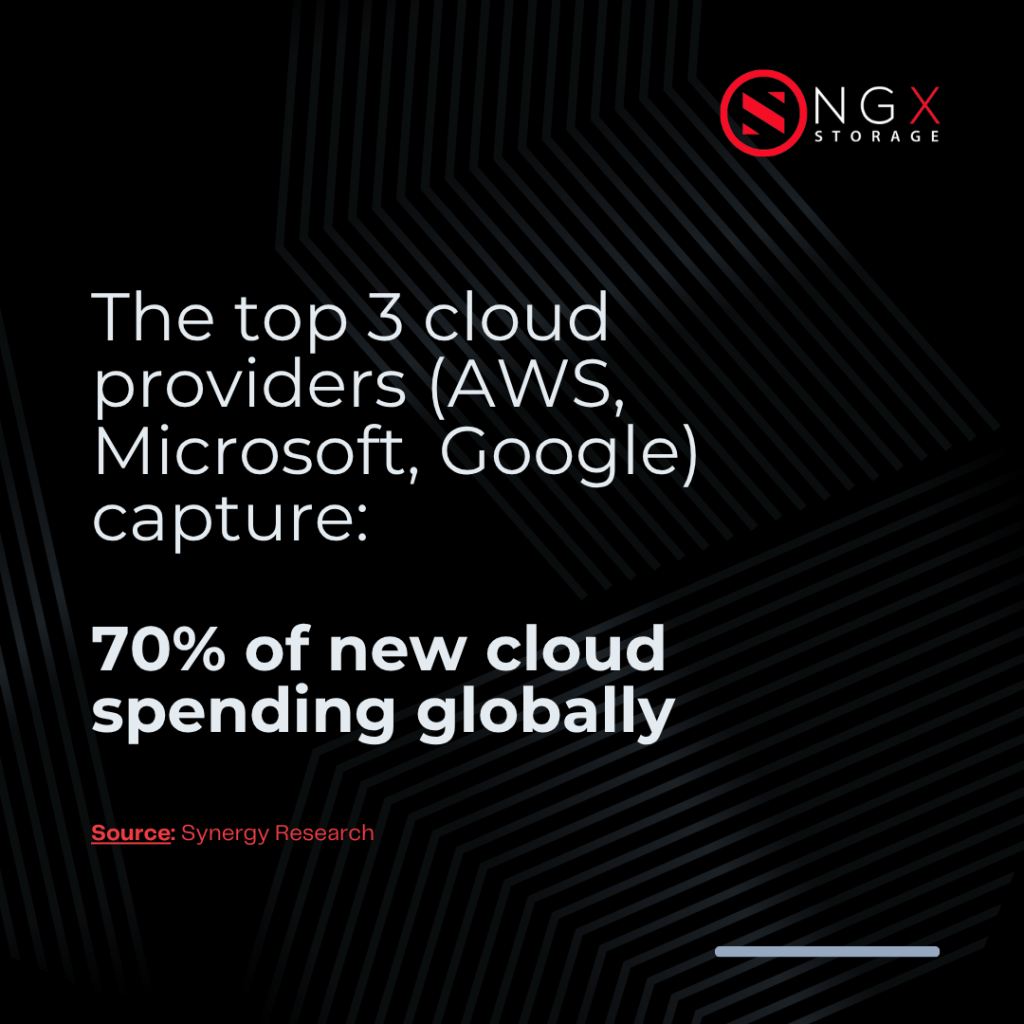
The same three hyperscalers continue to capture around 70% of new cloud spending globally. So this isn’t just about how things look today, it’s about how they are being reinforced for tomorrow.
And in practice, infrastructure decisions rarely happen in isolation.
Once an organisation builds on a particular ecosystem, every new workload, every expansion, every integration tends to follow the same path. Not necessarily because it’s the only option, but because it’s the easiest one. The most compatible. The least disruptive.
Over time, that creates a kind of gravitational pull.
Switching becomes more complex.
Dependencies become harder to unwind.
Flexibility starts to narrow without it being immediately obvious.
What begins as a rational, even efficient decision gradually turns into a long-term structural commitment.
And by the time organisations start questioning it, they’re often already deeply embedded within it.
Why Is This Conversation Accelerating?
Data sovereignty has been discussed in European policy circles for years. So why does it feel like the conversation is shifting now? A few forces are converging at once.
Geopolitics has made cross-border infrastructure dependencies feel less abstract. Organisations that once assumed stable, predictable access to foreign-governed platforms are thinking more carefully about what happens when that assumption breaks down.
Regulation is evolving. GDPR was just the start. Emerging European frameworks are pushing organisations to think not just about compliance, but about genuine control, over how data is used, accessed, and governed at a structural level.
AI changes the equation significantly. Training and running large models requires massive parallel data access, high throughput, and low latency. It also concentrates sensitive data in ways that make governance questions impossible to sidestep. When your AI environment runs on infrastructure you don’t control, the data sovereignty question becomes very concrete, very quickly.
Ecosystem lock-in is increasingly visible. Many organisations are only now realising how deeply embedded they’ve become, and how much effort genuine change would require.
The Architecture Question Nobody Wants to Ask
So naturally, the way organisations evaluate infrastructure is starting to shift.
Performance still matters.
Scalability is still non-negotiable.
But they’re no longer enough on their own.
There is a growing awareness that infrastructure decisions carry longer-term implications, not just for efficiency, but for control, adaptability, and resilience. As a result, new priorities are moving to the forefront: the ability to retain control over data environments, to remain flexible in how and where systems are deployed, and to adapt as regulatory and operational conditions evolve.
In sectors like finance, telecommunications, government, and healthcare, these are no longer “nice-to-haves.” They are shaping core strategy.
Because in these environments, infrastructure isn’t just supporting the business.
It is the business.
Where NGX Storage Enters the Conversation
This is where the challenge becomes more concrete.
It is no longer enough to scale infrastructure or optimise performance in isolation. The real requirement is to design systems that are open by architecture, systems that integrate seamlessly, evolve continuously, and remain resilient by design.
This is exactly where NGX Storage is positioned.
NGX Storage enables organisations to build unified, high-performance data environments that combine SAN, NAS, and Object storage within a single, scalable architecture. Instead of managing fragmented systems, organisations can consolidate workloads on one platform, without compromising performance or flexibility.
As workloads evolve, this becomes critical.
AI-driven applications demand massive parallel data access, consistent and predictable low latency, and seamless scalability as datasets grow. NGX Storage is designed to deliver this through scale-out architectures that maintain performance under load, not just on average, but where it matters most.
At the same time, organisations retain control over how and where data is managed. With an open software architecture, NGX environments integrate easily into existing ecosystems and adapt to changing regulatory and operational requirements, without forcing redesigns or vendor lock-in.
Modern data environments don’t stand still and infrastructure needs to keep up.
With NGX Storage, this translates into:
- Parallel, high-throughput architectures for AI, analytics, and real-time workloads
- A unified SAN, NAS & Object platform that reduces fragmentation
- Predictable performance under load, not just peak benchmarks
- Open architecture that ensures flexibility and long-term adaptability
- Simplified operations, with fewer layers and lower overhead
At its core, the shift is clear: infrastructure must remain adaptable, not restrictive, and NGX Storage is built to deliver exactly that.
The Next Phase Isn’t About Adoption. It’s About Design.
Europe’s data ecosystem was shaped by a decade of rapid cloud adoption. That was the right call for that moment. But the decisions that made sense in 2015 are being re-examined now, and the organisations doing that re-examination aren’t the slow ones. They’re the ones thinking ahead.
The shift happening isn’t about replacing one vendor with another. It’s about asking harder questions: What do we actually control? What can we change if we need to? What does our infrastructure look like in ten years if we keep building on the same foundations?
Data sovereignty, at its best, is an answer to those questions, not a compliance checkbox, but a design philosophy. One that puts performance, adaptability, and genuine control in the same architectural frame.
Europe’s next digital chapter won’t be written by whoever adopts the most cloud. It’ll be written by whoever builds the most intelligently. The organisations that recognise that shift early won’t just reduce risk, they’ll help define what European digital infrastructure actually looks like.